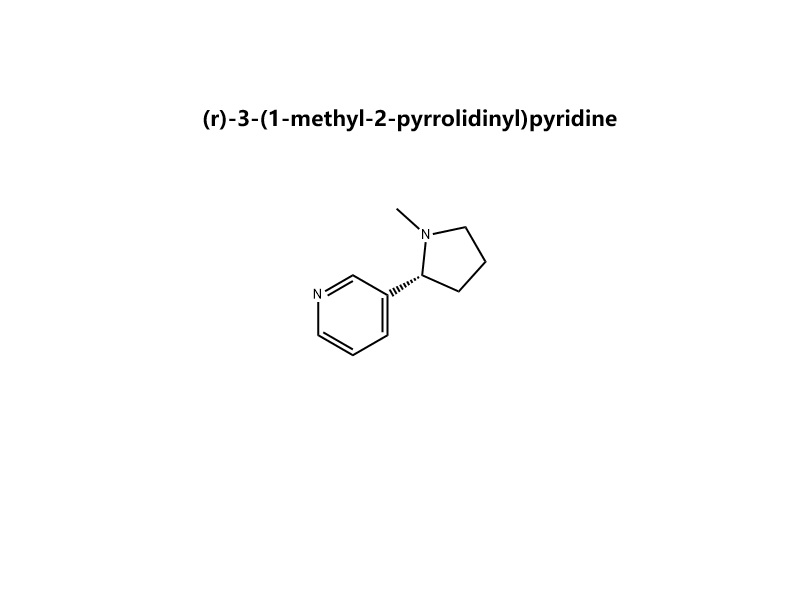
Nome IUPAC: (R)-3-[(2S)-1-Metilpirrolidin-2-il]piridina ou (R)-1-Metil-2-(3-piridil)pirrolidina
Nome comum: (R)-(−)-Nicotina; Nicotina Natural
Fórmula química: C₁₀H₁₄N₂
Peso molecular:162,23 g/mol
Rotação específica: [α]²⁰_D = aproximadamente -166° (puro)
Estrutura: Uma piridina (C₅H₄N) substituída na posição 3 com um grupo 1-metilpirrolidin-2-il com configuração (R).
Aparência: Líquido oleoso, transparente, de cor amarelo-pálido a acastanhado. Escurece quando exposto ao ar e à luz.
Ponto de ebulição: ~ 247 °C (decompõe-se)
Ponto de fusão: < -80°C (Líquido à temperatura ambiente)
Densidade: ~1,01 g/cm³ a 20°C
Pressão de vapor:~0,0425 mmHg a 20°C
Solubilidade: Miscível com água e a maioria dos solventes orgânicos (etanol, éter dietílico, clorofórmio) em todas as proporções a temperaturas abaixo de 60°C. Atua como uma base fraca (pKa do ácido conjugado: piridínio ~3,1, pirrolidínio ~7,9).
Estabilidade: Instável em condições alcalinas; volátil com vapor. Oxida-se e escurece após exposição prolongada ao ar. Os sais (ex.: dicloridrato, tartarato) são mais estáveis para armazenamento.
Farmacologia primária: A agonista potente dos receptores nicotínicos de acetilcolina (nAChRs)nos sistemas nervosos central e periférico. Essa atividade é a base de todos os seus efeitos fisiológicos.
Efeitos: Atua como estimulante em baixas doses, aumentando a frequência cardíaca, a pressão arterial e a liberação de neurotransmissores como dopamina (associada à recompensa e ao vício) e norepinefrina. Altas doses atuam como um agente bloqueador despolarizante nas junções neuromusculares, levando à toxicidade.
Toxicidade: Altamente tóxico (DL50 oral, rato: ~50 mg/kg). Os sintomas de intoxicação aguda incluem náuseas, vômitos, taquicardia, hipertensão, convulsões e insuficiência respiratória. Um conhecido teratógeno e substância vicianteDevido à sua rápida ação nos circuitos de recompensa do cérebro.
Metabolismo: Metabolizado principalmente no fígado pelo citocromo P450 2A6 (CYP2A6) em cotinina (principal metabólito) e outros compostos.
Biossíntese Natural: Na planta do tabaco (Nicotiana tabacum), é sintetizado nas raízes e transportado para as folhas. A via metabólica inicia-se com ácido aspártico e gliceraldeído-3-fosfato, passando por uma série de etapas que envolvem putrescina, N-metilputrescina e o intermediário crucial, o ácido nicotínico. O anel pirrolidínico deriva da ornitina/putrescina e o anel piridínico do ácido nicotínico (um derivado do aspartato). A enzima final, nicotina A sintase catalisa a reação de acoplamento, produzindo o enantiômero (R)-(−) naturalmente exclusivo.
Produção sintética: Pode ser produzido via síntese química ou extração e purificaçãoA partir de biomassa ou resíduos de tabaco, são utilizadas rotas sintéticas avançadas (síntese assimétrica, resolução enzimática) para produzir (R)-nicotina de alta pureza, evitando o enantiômero (S) indesejado, para aplicações farmacêuticas e de consumo avançado.

Produtos farmacêuticosTerapias para parar de fumar: O ingrediente ativo em Terapia de Reposição de Nicotina (TRN) Produtos (gomas de mascar, adesivos, pastilhas, inaladores) para aliviar os sintomas de abstinência.
Pesquisa Neurológica: Uma ferramenta padrão em pesquisa pré-clínica para estudar a função dos receptores nicotínicos de acetilcolina (nAChR), os mecanismos de dependência e potenciais terapias para a doença de Parkinson, declínio cognitivo e colite ulcerativa (onde os adesivos de nicotina demonstraram algum efeito).

AgroquímicosHistoricamente usado como um potente inseticida natural(atuando nos receptores nicotínicos de acetilcolina (nAChRs) dos insetos). Seu uso agora é altamente restrito ou proibido em muitos países devido à toxicidade para humanos.

Cigarros eletrônicos e líquidos para vaporizaçãoO principal agente viciante em produtos que contêm nicotina e-líquidosA mudança em direção à "nicotina sem tabaco" (TFN) geralmente se refere à (R)-nicotina produzida sinteticamente, comercializada por sua pureza e consistência.
Principais vantagens e benefícios
1. Especificidade e potência biológicas incomparáveis
Benefício: O O enantiômero (R) é a forma exclusiva que ocorre naturalmente.com estrutura tridimensional otimizada para ligação aos subtipos de nAChR de mamíferos. Isso garante efeitos precisos, reproduzíveis e biologicamente relevantesem sistemas experimentais.
Cenário de aplicação: Em pesquisa avançada em neurofarmacologiaAo estudar as vias de dependência ou a função cognitiva, o uso da (R)-nicotina elimina a variável de confusão do enantiômero (S) inativo, garantindo que os efeitos observados na liberação de dopamina ou na ativação neuronal sejam precisos e atribuíveis exclusivamente à forma ativa.
2. Fundamental para Pesquisa Validada e Padronização
Beneficiar:Serve como o padrão de referência definitivo para quantificar os níveis de nicotina e estudar seu metabolismo, toxicologia e farmacocinética.
Cenário de aplicação: Em toxicologia forense ou laboratórios de controle de qualidade farmacêuticaÉ utilizado para calibrar sistemas HPLC-MS/MS para a medição precisa de nicotina e seus metabólitos (como a cotinina) em amostras biológicas, garantindo resultados legal e medicamente defensáveis.
3. Essencial para o desenvolvimento moderno de produtos de nicotina
Beneficiar:Fornece um Ingrediente farmacêutico ativo (IFA) consistente e de alta pureza.Livre de impurezas específicas do tabaco (TSNAs) que podem surgir durante a extração, o que é crucial para os perfis de segurança.
Cenário de aplicação: No desenvolvimento de terapias de reposição de nicotina (TRN) de próxima geração ou sachês regulamentados sem tabacoA nicotina sintética (R) permite uma dosagem precisa, perfis de sabor mais puros e um argumento regulatório mais robusto em relação à pureza e caracterização do produto.
4. Possibilita estudos de relação estrutura-atividade (SAR)
Beneficiar:O enantiômero puro é o andaime fundamentalPara que químicos medicinais possam projetar e testar novos análogos para potenciais terapias direcionadas aos receptores nicotínicos de acetilcolina (nAChRs).
Cenário de aplicação: Em programas de descoberta de medicamentos para distúrbios neurológicos(por exemplo, Parkinson, esquizofrenia, dor), os pesquisadores modificam a estrutura da (R)-nicotina para criar novos compostos com atividade seletiva em subunidades de receptores, visando manter os benefícios cognitivos e, ao mesmo tempo, eliminar o potencial de dependência e os efeitos colaterais.
(R)-3-(1-Metil-2-pirrolidinil)piridina (Nicotina natural (R)-(−)-, CAS 25162-00-9) não é um produto químico básico, mas sim um Ferramenta bioquímica altamente especializada e ingrediente ativo de precisãoSua principal vantagem é a sua pureza enantiomérica, que está diretamente ligado ao seu eficácia biológica, validade da pesquisa e aceitabilidade regulatóriaÉ indispensável para Pesquisa neurológica de ponta, padronização analítica e desenvolvimento de produtos avançados e bem caracterizados para administração de nicotina.Para pesquisadores e desenvolvedores de produtos, obter nicotina (R) de alta pureza é um investimento em integridade de dados, consistência do produto e credibilidade científica, diferenciando seu trabalho de estudos ou produtos que dependem de misturas racêmicas menos definidas.
Perguntas frequentes (focadas no cliente)
Q1: Qual a diferença entre (R)-nicotina e nicotina racêmica?
A: O O enantiômero (R) é a forma biologicamente ativa que ocorre naturalmente. com alta afinidade pelos receptores nicotínicos de acetilcolina (nAChRs). A nicotina racêmica (uma mistura 50/50 das formas (R) e (S)) é frequentemente um subproduto da síntese química não estereosseletiva. O enantiômero (S) apresenta afinidade significativamente menor pelo receptor e farmacocinética diferente. Para pesquisa e aplicações de ponta, enantiômeros A pureza (>99% (R)) é crítica. Para uma resposta biológica precisa e um desempenho consistente do produto.
Q2: Quais são os requisitos críticos de manuseio e armazenamento?
UM: Extrema cautela é necessáriaDeve ser tratado em um capela de exaustãoCom EPI apropriado (luvas, óculos de proteção, jaleco). Armazene em local arejado. atmosfera inerte (Argônio/N₂) em um recipiente escuro e hermeticamente fechado at 2-8°CComprar e armazenar isso como um forma de sal estável (por exemplo, dicloridrato) é fortemente recomendado para maior segurança e prazo de validade. Consulte sempre a Ficha de Dados de Segurança (FDS).
Q3: Quais são os graus de pureza disponíveis e qual devo especificar para minha aplicação?
A:
Grau técnico (aproximadamente 95%):Para aplicações industriais não críticas (ex.: pesquisa de inseticidas).
Grau farmacêutico (pureza química >99%): Obrigatório para o desenvolvimento de produtos NRT.
Alto grau de pureza enantiomérica (>99,5% (R)): Essencial para Pesquisa avançada em neurofarmacologia e TFN sintético para líquidos de vaporização.Onde a interação precisa com o receptor e o perfil de sabor são fundamentais. Sempre especifique. pureza química, excesso enantiomérico (ee) e níveis de solvente residual.
Q4: Qual é o panorama regulatório para a compra e utilização deste composto?
A: É fortemente regulamentadocomo substância controlada/precursora na maioria das jurisdições.
EUA: Regulamentado pela FDA e pela DEA. As vendas são frequentemente restritas a instituições de pesquisa qualificadas e fabricantes licenciados.
UE: Sujeitos a rigorosos controles de acordo com as regulamentações de segurança química e do consumidor (por exemplo, REACH, CLP). Para produtos de vaporização, a Diretiva de Produtos de Tabaco (TPD) estabelece limites de concentração.
Conformidade: Os compradores devem fornecer documentação de uso finale comprovação de conformidade com as regulamentações locais. Para uso comercial em produtos de consumo (cigarros eletrônicos), são necessários dossiês toxicológicos abrangentes e autorização de comercialização.
Q5: Pode ser usado como padrão em testes analíticos?
UM: Sim, é o padrão de referência primário.Para quantificar a nicotina em amostras de tabaco, farmacêuticas e toxicológicas por meio de HPLC, GC-MS ou LC-MS. Para isso, você deve obter um Material de Referência Padrão Certificado (CRM)De um fornecedor qualificado, com certificado de análise que detalhe a pureza exata e a rastreabilidade.
Q6: Quais são as principais considerações logísticas e de fornecimento?
A: Devido à sua classe de perigo (6.1, tóxico), transporte especializado de mercadorias perigosas (HAZMAT)É obrigatório, aumentando o custo e a complexidade. Os prazos de entrega podem ser longos. Fonte: fornecedores de ingredientes químicos finos ou farmacêuticos de boa reputação e estabelecidos Com experiência comprovada no manuseio de alcaloides. Desconfie de discrepâncias nos preços, pois preços muito baixos podem indicar misturas racêmicas, baixa pureza ou fornecimento irregular.


 Português
 English
 Español
 Português

![4-Nitrophenyl 3-(Benzo[d][1,3]dioxol-5-yl)-2-methylpropanoate](https://pt.qixiolivetol.com/storage/uploads/images/202604/17/1776427287_qZy87IjHSQ.jpg)

 CONTATE-NOS


 IPv6 SUPORTADO POR REDE
|
IPv6 SUPORTADO POR REDE
|